Has to be one of the greatest protest songs (written by Phil Schlein) from the 1960s, beautifully delivered by Barry McGuire....

Notes for Chat with Traders, Episode 117
Episode 117 ... Larry Alintoff (72:00)
- Lives in Florida
- Sounds like a New Yorker
- Trading for 30 years
- University of Michigan grad
- Sophomore year of college, watching FNN on day of 1987 crash -- hooked him on markets
- Born in 1967
- Started plotting prices on graph paper in his dorm room
- Read as many books about trading as he could
- Discovered "pressure points"
- Ascending triangle, or sideways action [he discovered coiling, power of ever narrowing range]
- High frequency traders sniff out order flow and run ahead
- Worked at RefCo, forex broker, odd hours from 2 PM to midnight
- Worked for Paul Tudor Jones
- Reminiscences of a Stock Operator (favorite book)
- "Yuge"
- "... if that makes sense." Ends a lot of sentences with this phrase
- Paul Tudor Jones staked him and a group of people a bit of money
- Traded from a little office at RefCo
- "Yuman psychology"
- No guidance from Jones or his people
- Jones kept close tabs on positions of all the people he staked, created "sentiment indicator"
- All people who trade for a long time evolve
- Friend trading stock options on the American Stock Exchange, he joined him
- Profits just handed to you there, no need to think or understand what you were doing
- American Stock Exchange had no competition, everyone must see specialist on floor
- Other exchanges started to make markets in options, spreads narrowed with competition
- Pacific Coast, Boston, CBOE broke up American Stock Exchange monopoly
- Went to New York Board of Trade, worked in frozen concentrated orange juice pit
- Good traders can separate signal (good information) from noise
- What should happen versus what did happen? Pay attention to that
- People who grow oranges know the orange juice market better than guys on the floor
- Have a point where you know you're wrong, and get out
- He takes profits too quickly
- Make sure no one trade really hurts you
- When Trump won and the market should have gone down and didn't, that was valuable information
- Turns over his portfolio every five days
- Holds 80 - 100 longs and 80 - 100 shorts
- Computing power today so great, he can filter thousands of stocks for his criteria in a minute
- Larry has yellow pads, he's not a programmer, gives his ideas to the young programmers
- Knew the floor was coming to an end, everything going electronic
- Had to figure out how to do what he did on the floor once he was off the floor
- Hated weekends, couldn't trade then, deeply depressed every Friday afternoon
- Obsessed with markets for 30 years
- He's not a quitter, not lazy ... a workaholic about the markets
- "Yuman nature" will never change ... fear and greed still exactly the same, elation and despair
- Keeps a low profile
- Twitter: @AlintoffLarry
Notes for Chat with Traders, Episode 118
Episode 118 ... Manoj Narang (58:47)
Sharp guy, interesting episode.
- Has new fund: "MANA Partners"
- Formerly of Tradeworx (left July 2015)
- Quant trading the way to go
- IP has more value than PL you can generate (does that make sense?)
- Bringing high frequency trading to asset management investors
- Double digit Sharpe ratios, most not comfortable with this
- Started at First Boston, 1991, equity derivatives desk
- Front office technologist supporting trading desk
- 8-9 year career on Wall Street
- Knew nothing about Wall Street when in college
- Never took a statistics class, finance class, economics class
- Studied theoretical math and computer science (algorithms, graph theory)
- Reasoning quantitatively and thinking logically are the key skills
- Algorithmic trading is a quantitative challenge
- At Goldman Sachs in late 90s, favorite job, phenomenally smart people
- Trading manually back then was exhausting, nothing electronic
- Burned out, wanted to start tech firm
- Online brokerages to 40% market share in late 1990s, boom
- Early adopter of Datek, 1996
- Could build tools to help mainstream investors
- Started Tradeworx
- "Analytical decision support tools"
- 2001 -- Dot com bubble burst, 9/11 happened, everything changed
- Tradeworx became a hedge fund then
- Why would a hedge fund commercialize its technology?
- 2008 a difficult year for hedge funds, Lehman demise
- Started high frequency trading in 2008
- Eventually became a large high frequency trading firm by volume
- Example of valuable IP: intraday trading signals, "MIDAS" bought by SEC to monitor markets
- Early adopter of Amazon Web Services, tick data storage
- Consolidated audit trail, successor of "OATS" owned by FINRA
- Giving regulators investigative powers in modern, fragmented markets
- Thesys, an offshoot of Tradeworx, won audit trail contract
- Quantitative trading -- hypercompetitive, zero-sum
- Paranoid conspiracy theories abound about high frequency trading
- Inequality is a natural aspect of any system
- Engineer systems to compete after studying the rules (which are complicated)
- Questions of fairness, but it's really about discrepancies of skill [one way to rationalize it]
- Simplify the regulatory regime, too many rules to understand
- Proprietary traders are largest beneficiaries of HFT, then it trickles down
- Fragmented markets glued together by HFT
- Several dozen trading venues, both lit and dark
- Quantitative investing strategies now very crowded
- All quants use the same data, same inputs, so use of non-traditional data now key, such as:
- Twitter firehose, e*commerce data now mined, satellite imagery
- Discretionary managers not worth the fees they charge
- If you charge high fees, must empirically show you deserve them, no one can
- RenTech, successful quant hedge fund, all employee owned now, no outside money
- Secular trend towards mechanization, automation of investing process
- Look for patterns in non-traditional data
- Renaissance in artificial intelligence now, "machine learning"
- Quantitative trading is tolerant of noise
- Statistically orthogonal signals
- Humans control the capital, not the quants
- Quants have super short holding periods, generally
- New datasets have very limited histories, so model building from them also limited
- Investment success comes from bucking the trend
- AQR, DE Shaw, RenTech ... you won't succeed if you try to copycat them
- Think for yourself
- www.mana-partners.com
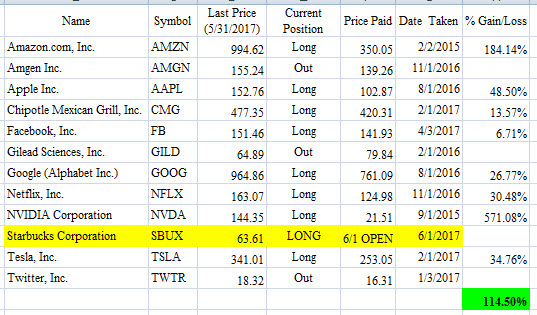
Dirty Dozen, Long Only Portfolio, End of May 2017
One change to the Dirty Dozen portfolio, getting long Starbucks (SBUX) on June 1. Amgen, Gilead, and Twitter remain on the sidelines for now. NVIDIA beat earnings and went quite a bit higher since the last post. Changes in 2017 include getting long Chipotle and Tesla in February and Facebook in April.
Notes for Chat with Traders, Episode 119
Episode 119 -- @TAGRtrades (60:51)
- "Alex"
- Interested in trading in college, age 19 or 20
- Waiting tables, summer job
- Opened e*trade account with 2 or 3K savings
- Dad suggested ag stocks
- Retired Dad has CNBC on all the time
- Grew up with Jim Cramer shouting on TV in background
- Never thought about being a trader
- Sounds like a Southerner, Texas maybe?
- Worked in software
- Used Yahoo Finance for research
- Serious beginner's luck, made 20-30% on first trades
- Solar stocks going nuts
- Read message boards
- Earthy guy all behind this solar thing
- Put all his money in one small solar stock [doesn't say symbol]
- Hands shaking, up 20K in one day
- Frozen excited and scared
- Told his wife he was quitting his job and going full time
- Went 8 for 10 when he didn't know what he was doing
- 25 years old, had some savings, wife had nanny job, no downside
- We're going to get rich quickly!
- Selling parents and in-laws on day trading much harder
- Plowed through dozens of trading books
- Had a written trading plan from the start
- Quickly realized he didn't know what he was doing
- Google search: how to make money in small caps
- He did have security of being able to go back to software job, but never has
- Spent thousands on alert services, chat rooms, DVDs
- Learned horrible habits: averaging down
- Red months for first six months
- Green months ever since (not huge green but green)
- Wife working, one check coming in, cut expenses way down
- No steak and champagne dinners with the occasional winner [or cigars]
- He did have a dollar figure in mind where he'd quit
- Tried trading options or futures -- whole 'nother world
- Tried to short, didn't suit his personality
- Learning experiences of what not to do
- Talks a lot about trading with his wife [she must be an angel]
- He didn't know what he didn't know, just made the leap
- Wouldn't want his kids to trade -- the work is just too hard
- Risked 2% in early trades, so he never blew up
- Never once traded on margin, so he never blew up
- You never hear from loser traders once they blow up, they disappear
- First two years, profit curve: big spikes, big drops
- Averaging down is still his biggest fault
- Took a year to figure out averaging down is terrible thing to do
- Good, knowledgeable chat guys are really helpful [but rare]
- Nobody cares about how you manage a trade, or control your emotions
- Track your progress, "journaling"
- Must figure out what works for *you*
- Get into the hot sector, you have a bid under you [a tailwind]
- Chat with Traders podcasts were super useful to him
- Constantly trying to evolve
- Looks for specific set-ups, at specific times of day
- 3-4 stocks in play
- Plays small cap garbage stocks that will eventually do an offering
- Been trading for four years but considers himself new
- Chart set-ups that work intraday also work on longer time frames
- "Grade A" setup -- something going bananas, looks for sector sympathy plays
- Scales in and scales out
- Gotten good at controlling his emotions, seeing chart clearly
- Favors longs over shorts due to his personality
- Doesn't want 11 good years of trading, and then blow out with one trade
- What if your computer turns off and you're in over your head?
- Used to play off scanners or people's trade alerts, no more
- Comes in with 3-4 stocks each day, sets stop levels where trade no longer makes sense
- He will put a third of his account in a single trade
- Knows where he's going to get out
- Takes starter positions then builds position
- Tries to go home green every day
- Hard to let winners run, psychologically hard *not* to take profits
- First trade is smallest then larger then larger, as soon as it works take part off
- Size is based on your confidence
- Spends $1000+ a month on scanners and charts
- Microsoft OneNote for trading journal + Excel spreadsheet
- Time consuming to enter each trade but worth it
- Works from home, just talks to himself all day [thus wife's suggestion to join Twitter]
- Final notes at end of day
- EdgeWonk, enters detailed information, time of day -- useful tool -- coupon code "traders"
- Can find one or two trades a day
- Wants to slowly increase his size
- Still has never traded with margin
- Does zero swing or position trading
- Journal tells him that he shouldn't trade stocks under a dollar
- Figure out what you're comfortable doing, must fit your personality
- Can't fit in somebody else's mold
- Just grind, no margin
- www.tagrtrades.com
- Twitter: @TAGRtrades
Notes for Chat with Traders, Episode 120
Episode 120 -- Mebane Faber (72:32)
- Biotech equity analyst [which firm?] while going to grad school
- Moved to LA in 2006
- Started Cambria 2007
- Chatted about stocks with his father growing up
- Worked for a CTA
- Interested in trend following
- [What is Cambria? Research maybe? Not clear....]
- Money management, ok they have mutual funds
- Enjoys skiing
- Everything they do is rule-based, quantitative
- Value investing + trend following the ideal
- Mutual fund managers skim 1.25% [How much does Cambria skim?]
- Fund managers know their product is expensive and tax-inefficient, so they don't buy it
- Triumph of the Optimists (his favorite book)
- Global Investors Yearbook by Credit Suisse (great, free resource)
- 5-2-1 Rule ... Stocks 5% Bonds 2% Bills 1% (real long-run returns)
- Market-cap-weighted indexes, price of the stock times shares outstanding
- US is half of world market cap
- Home country bias, gives you concentration risk
- [Does Faber have a CFA?]
- Maybe 20% of the stocks contribute all the positive returns
- It's the best time to be an investor in the history of investing (low cost portfolios)
- Robo-advisors -- re-balance for you, tax-manage them for you
- Fund business very predatory, high fees, tax inefficient
- There are even ETFs now that have a negative expense ratio
- Index funds -- market-cap-weighting, low turnover, low cost
- Change weighting methodology, you'll outperform market-cap-weighting
- Start with US 60-40, then add global, then add real assets
- Then move away from market-cap-weighted to momentum (trend following) and/or value
- Wealthfront, Betterment [never heard of them]
- Most people don't have a written investment plan
- Emotional component of long-term investing the hardest, people panic
- January 2000 the AAII survey was at its most bullish ever (greed)
- March 2009 the AAII was at its most bearish ever (fear)
- Why pay an advisor 1% a year? [Big expense best avoided]
- 10-year PE ratio as anchor, gives you common sense check (CAPE ratio)
- Japan was half of global market cap in the late 1980s
- Correct mathematical choice is to invest all of your money right now (global multi-asset class portfolio)
- Rebalance tax efficiently
- Afraid he's putting listeners to sleep
- Taxes (high turnover) and fees (high fees) way more important than asset choices
- Hedge funds sexy but taxes and fees are killer
- Average mutual fund fee 1.25% would kill the best performing portfolio to worst performing over the long term
- People should think about fees (and taxes) and almost nothing else
- People struggle with their emotions the most
- They don't teach personal finance or investing in high school or college
- They don't teach how to manage money in school
- Mutual fund salad -- people hold 30 funds ... just sell everything and start over (consider taxes)
- People outside US esp. killed by fees (no Vanguard)
- www.mebfaber.com
- Twitter: @mebfaber
ETF Trading Portfolio Update -- May 29, 2017
No changes this week.
(Recall that we've dropped DZZ and replaced it with GLL ... I'll remove the DZZ line item in next week's posting.)

ETF Trading Portfolio Update -- May 22, 2017
No changes this week.

Notes for Chat with Traders, Episode 121
Episode 121 -- Michael Mauboussin (57:11)
- Pronounced Mo-bisin (like Larry Curly and Mo)
- Works for Credit Suisse
- Liberal arts major
- Did training program at Drexel Burnham Lambert
- Gravitated to research
- Junior analyst job
- Hired by First Boston, early 1990s
- Morphed into a "Strategist"
- Teaches at Columbia Business School
- 25 years of teaching security analysis
- Kahneman, Tversky behavioral studies: humans rely on rules of thumb with decision making
- Humans have cognitive limitations
- Auditing quality of decision making
- Valuing process over outcomes
- How much of a role did luck play?
- Heuristics and biases -- shorthands lead to biases
- Prospect Theory
- Overconfidence -- projecting narrow outcomes
- Confirmation bias -- we seek information that confirms view, dismiss new information
- Recency bias -- weighting recent events, not a larger sample size
- How to combat confirmation bias? Keep an open mind
- Phil Tetlock -- "beliefs are hypotheses to be tested, not treasures to be protected"
- Bayes Theorem -- new information, update views
- Your views should be tenuous [tell that to a priest!]
- Framing -- how you present the problem skews things
- Intuition is robust in a stable or linear realm (chess)
- Usefulness of checklists -- pilots have them, keeps them consistent
- Do-confirm checklists
- Read-do checklists (for emergencies)
- Stock down 10% versus the market, investors take out their read-do checklist to react calmly
- "Think twice" -- inside outside view
- Analysis paralysis -- some domains more information *isn't* better
- Paul Slovic -- tested handicappers, accuracy of bets didn't get better with additional information, but confidence soared
- Professionals don't want too much information, just the key information
- How to combat indecisiveness: do you need to move or not?
- Technique to get you moving: write down plus / minus columns
- Techniques to surface alternatives: "pre-mortem" pretend decision worked out *poorly* by projecting into future
- Spend as much time as you can reading, exposing yourself to different points of view
- Cognitive neuroscience
- Hyperbolic discounting -- future self is good, self at moment is bad
- Humans want immediate gratification while promising to be good in the future
- Link things you like with things that you don't like
- Treadmills (hard) and podcasts (fun) -- one way to motivate self
- Split brain patients -- left versus right hemisphere activity
- Left hemisphere has the "interpreter" -- links cause and effect
- Humans love stories (narratives)
- Statistical arguments are palid, while a story is salient
- Be a good storyteller, don't spout dry statistics
- "Tales from Both Sides of the Brain" -- good book
- Gazzaniga Scientific American articles
- Keep a journal of your decisions (date and time it)
- Go back and audit quality of decisions
- Hindsight bias and creeping determinism
- Skill dominant games -- the best player wins
- But games where probability matters, process is all important
- Good outcomes, horrible process
- Adherence to good process, will win over time
- World is dynamic, can only have components of process
- Process must be transparent, economically sound, mathematically devised, repeatable
- Fascination with Richard Dennis, Turtle Traders
- Curtis Faith book on Turtles
- Skill versus Luck
- Mauboussin an avid athlete
- Loved Michael Lewis's Moneyball book -- sticking to process
- Taleb's 2001 book didn't quantify where the randomness was [annoying]
- Short run luck will dominate, long run will zero out; then skill will shine
- Techniques to isolate skill from luck
- 82 NBA games a season, large enough sample to work with
- All great investors think probabilistically
- All great investors always have odds in their favor (positive expected value)
- All great investors understand the role of time
- Live to see another day -- "preserve optionality"
- Puggy Pearson advice best: Understand the 60:40 end of a proposition (edge), money management (how much to bet), and knowing yourself (know your psychological shortcomings)
- www.michaelmauboussin.com
- Twitter: @mjmauboussin
Notes for Chat with Traders, Episode 122
Episode 122 -- Doug Cifu (39:38)
- Co-founder of Virtu
- Formerly a corporate lawyer
- Formerly a partner at Paul, Weiss, Rifkind, Wharton & Garrison in NYC for 18 years
- Fast talker, sounds like native New Yorker
- Private equity firm General Atlantic a client
- General Atlantic had idea that exchanges would become electronic, for-profit
- He was the lawyer representing GA in all their investments
- Met New York Mercantile Exchange (NYMEX) chairman: Vinnie Viola
- Vinnie Viola asked him to leave Paul, Weiss and partner with him to found Virtu in 2008
- Virtu is an electronic market making firm
- "Old school market maker" using latest technology and automation
- Vinnie was a local risking his own capital, just wanted to make a tick
- Provider of liquidity without customer order flow
- Doing one thing, doing it well, and repeating it
- Latency arbitrage isn't illegal or immoral
- Data centers in New Jersey, data centers in Illinois
- Spread Networks: it's not evil, it's just commerce
- Evolved to microwave network transmission, even faster
- Being faster by a microsecond isn't a sustainable business model
- Virtu takes no directional trades, they think they can make a tick
- They don't pray for mean reversion
- Trading 4.5MM times a day
- Bias based on bid side or offer side being stronger, classic market making
- The old rewards available to market makers don't exist anymore
- For example, specialists got 25 cents a share (the spread) in 1982 on NYSE for holding inventory on blue chips
- Wins 51% of time (usually) ... will never disclose scratch percentage [but it's obviously huge]
- Michael Lewis running around with his hair on fire
- Big barrier to entry to what they do, smaller firms can't succeed
- Madison Tyler consolidation in 2011
- To be US equities electronic market maker, costs are enormous ($70MM a year), market data, connections
- Co-location at data centers, infrastructure, footprint incredibly expensive, wouldn't be profitable for equities alone
- Their business is a scale business
- Little guys can't make it, must sell out (to Virtu)
- Putting out bids and offers is taking risk, so lots of pre-trade risk controls, including human involvement
- Hubris is a horrible vice
- Virtu went public April 2015
- One losing day in five years, operational error, mistake to put that info in, Cifu's fault
- Not an arrogant cocky firm ripping people off
- We're not swinging for the fences, just hitting singles
- Regretted putting "stupid histogram" out there
- Guys at ZeroHedge writing crap about it
- Michael Lewis's book true of market in 2009 but not 2015, "didn't really know what the hell he was talking about."
- Lewis is anti-money, anti-Wall Street ... "he's a capitalist dressed up like a communist"
- Lewis wrote fictionalized nonsense
- Markets have gotten more efficient, it's *better* than the old days because of firms like Virtu
- He was "a reasonably smart young man"
- Worked his ass off in high school, got into Columbia, worked ass off there
- Got into Columbia Law School, worked ass off, got into Paul Weiss, worked ass off to become a partner
- Kept eyes open, learned a lot about a lot of different things, was well rounded
- Worked on top-flight deals, big M&A deals, exposed to a lot of stuff
- Met Vinnie Viola, became good friends, they worked well together
- Need some innate ability, but he's "the dumbest guy at Virtu," must work your ass off
- Hire really smart people and empower them
- Be modest enough to know what you don't know
- No politics at Virtu, flat organization
- His success based on hard work, many people helping him out along the way
- No clue about financial markets in 2008
- Titles are bullshit, don't have them at Virtu
- "I'm a smart guy, I can figure it out"
- Vinnie took the risk on a "loud-mouthed lawyer" like him
- Client used to call him "Dougie Large, the man in charge" (because he's a little overweight)
- Twitter: @Dougielarge